
“Compostable” on its own tells you very little. It can mean home composting or industrial composting.
Industrial composting needs a purpose-built plant. Few in Britain accept packaging, and councils generally don’t want it in food waste bins, so “industrially compostable” packaging usually ends up in landfill.
My first batch of bags was a case in point. They were certified for industrial composting only. I returned them for a refund.
Real cellulose film is the genuine alternative. It is made from wood pulp and the version I use is certified for home composting. It is hard to find and expensive. Most of what is sold as “cello” today is oil-based.
Ask for the certification mark and licence number. A company that can’t tell you what it covers probably doesn’t know.
To call this gesture a drop in the ocean would be generous. It is less than a drop . . . When I look at the enormous quantity of plastic we use in everyday life I feel saddened that we pay so little attention to it.
It felt important to me that my business didn’t add to this ever-increasing mountain of plastic packaging waste we generate. It may be a futile gesture but perhaps if all of us tried to act in accordance with our conscience we could make a difference.
The envelopes I needed in the right size were finally delivered a week ago and I am delighted with them. Getting here, though, was an education in what makes an envelope truly compostable and taught me about the misleading language used to capitalise on people’s concern for the environment.
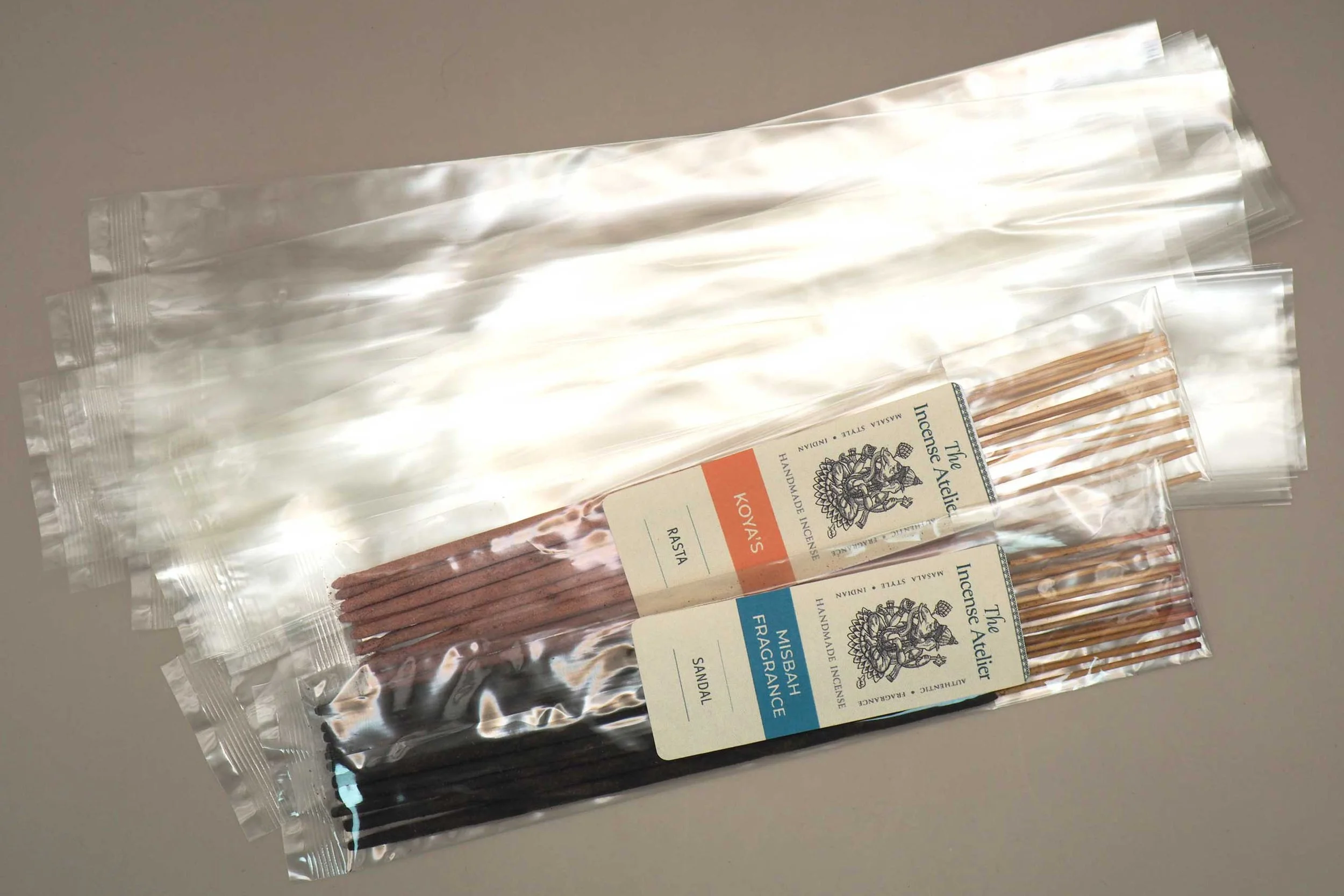
The final home compostable incense envelopes
A first attempt that wasn’t what it claimed
My first attempt was a batch of 3,000 clear bags sold as “compostable”. They were made from a plant-based bioplastic that is certified only for industrial composting. The word “compostable” sat prominently on the product page while the important details were located elsewhere. The certificate also covered only the base film and not complete item, not the finished bag with its adhesive tape. Other claims on the page, about recyclability and about what the certification meant, did not match the film maker’s own documents. I used a few hundred bags and then stopped. Something didn’t feel right. By then I had understood that a bag which would break down only in a composting plants that was never going to receive it – the so-called “industrial composting” – was not doing the job I had bought it for. I discussed it with the seller who agreed and (all credit to them) provided a full refund.
Why industrial composting rarely happens
The trouble with industrial composting is that it needs an industrial composter. The standard (EN 13432) asks for breakdown within 12 weeks under industrial-scale conditions, and those conditions are elevated temperatures of 55 to 60°C with high humidity and oxygen. The important point I discovered is that few plants in Britain will take such packaging. Most household food waste goes to anaerobic digestion, and digesters can’t break down most so-called compostable packaging. One council puts it plainly: compostable bags are removed mechanically at the facility, which can’t tell them from ordinary plastic. The same council lists food packaging, even compostable packaging, among the things it does not want in the food waste caddy. England’s weekly food waste collections only began this spring in some areas. Advice does vary from council to council, but there is no UK-wide system for collecting and processing compostable plastics, and packaging sent by households for composting has been reported ending up in landfill. A bag that can only be composted industrially has very little chance of ever being composted. It should also be kept out of conventional plastic recycling, which it contaminates. (see link at end of article)
Press for detail
“Compostable” is a lovely word and companies know it. It carries a great deal of goodwill and very little information. Compostable where, under what conditions, and how quickly? Does it include the tape, the ink and the glue? On my first batch none of those answers was on the product page, and some of what was there turned out to be wrong. It took persistent questions, a deadline and a mention of Trading Standards before the seller agreed to correct the page. I found the same claims repeated on several other sellers’ websites. Whether by design or carelessness the effect is the same: a claim that is true of one component gets applied to the whole product and continues because nobody asks. So ask. Properly certified compostable products carry a certification mark and a code number. Ask for that number, ask whether it covers the finished article, and ask what will actually happen to it in your own council’s bins. A company that cannot answer probably does not know, and without the answers the word on its own is often close to meaningless.
So I went in search of something different and rediscovered cellulose.
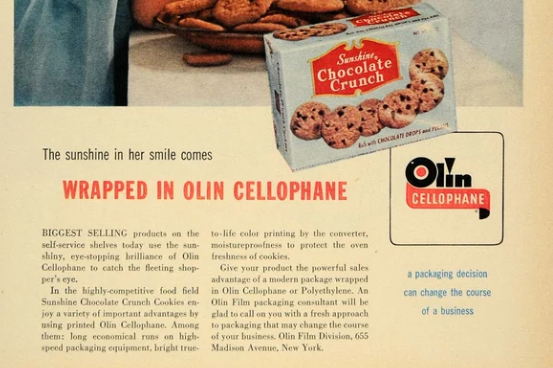
Early Cellophane advertising.
What “cello” used to mean
Cellophane was invented in Switzerland in 1908 and named from “cellulose” and “diaphane”, meaning transparent. It was a clear film made from wood pulp and for a long while it had the field to itself. Then cheaper petrochemical-based films (polyethylene, polypropylene and PVC) largely replaced it yet the name stayed behind. Today almost any clear and crackly wrapping is called cellophane or “cello” whatever it is made of. It has entered our collective language like Hoover or Biro. Real cellulose film is still made but I found it surprisingly hard to find. It is expensive and more expensive still to have made into envelopes of the right size. One converter could only make my size in the bioplastic and another could do cellulose only at a minimum order of 300,000. I did find one maker in the end, at three thousand. The word is everywhere yet the genuine material is hard to come by.
OK Home Compost Symbol via TUV Austria
The envelopes I have now
Incense Atelier’s new envelopes are made from NatureFlex, a clear film made from wood pulp and not from oil (petrochemicals). Cellulose is what paper is made of. The film is certified to EN 13432 for industrial composting and to ‘OK Compost Home’ which tests at ambient temperatures below 30°C. That second certificate is the one that mattered to me. Many garden heaps never reach the heat or conditions of an industrial plant. The maker says the film breaks down in a matter of weeks in home compost systems.
Composting them at home
The envelopes arrive plain with no adhesive strip. I seal them with a small fully compostable adhesive circle. A crumpled envelope will break down faster than a flat one, and a warm and damp heap faster than a cold dry one. In winter it will simply take longer.
I’ll be burying one in my own compost to see for myself and note the results.
1. “Abel & Cole is “urgently” scrapping all compostable plastic packaging from its range after it emerged the material only broke down under very specific conditions”. The Grocer. August 2022