A classic musky kasturi with floral depth — rich, warm, and quietly spicy.
Kasturi is one of the oldest and most revered fragrance materials in the Indian tradition, and not always the easiest on a first encounter — we've written about exactly that in the journal, if you're curious: On Liking Difficult Scents. Misbah's Ruh Kasturi presents it with confidence. The name is worth a moment's attention: ruh in the Indian attar trade denotes a pure distilled essence rather than a blended accord — a signal that kasturi is the central, undiluted subject of this stick rather than a background note folded into something else.
The stick itself is immediately distinctive — a deep purple, hand-rolled with a generous paste and finished with melnoorva powder. On the cold stick the kasturi is direct and present: peppery, uncompromising, but not aggressive. On the burn it softens and opens, the floral notes coming forward to balance the musk — warm and spicy underneath, more rounded and complex on top.
This is the Misbah incense to reach for when you want something rooted in the classical musky register of Indian domestic fragrance — the kind of scent that has been warming homes across the subcontinent for generations.
This is not pale, creamy sandalwood. Misbah's Sandal works deep in the wood — oily, dark, with a strong oudh undercurrent that gives it weight and complexity. The floral notes are present but they are dark florals: heady rose tones rather than anything light or powdery, so the overall effect remains in the rich, enveloping register the house does so well.
Bold, sustained and lasting on the room. Reviewed by Incense in the Wind.
Rose at its most opulent
Rose Oudh arrives with presence. The cold scent on the stick is already heady and affirmative — a full, Arabian-register rose, unmistakably Damask, with a dark oily undertow that tells you exactly where this is going.
On the burn it opens up beautifully. The rose stays at the centre but doesn't dominate unchecked — it's balanced by woods and musks that pull it earthward, keeping the sweetness from becoming cloying. The overall effect is warm, a little sultry, genuinely complex.
If you have any interest in the richer bakhoor-influenced tradition of Indian incense, Rose Oudh is an excellent place to start with Misbah. Reviewed by Incense in the Wind.
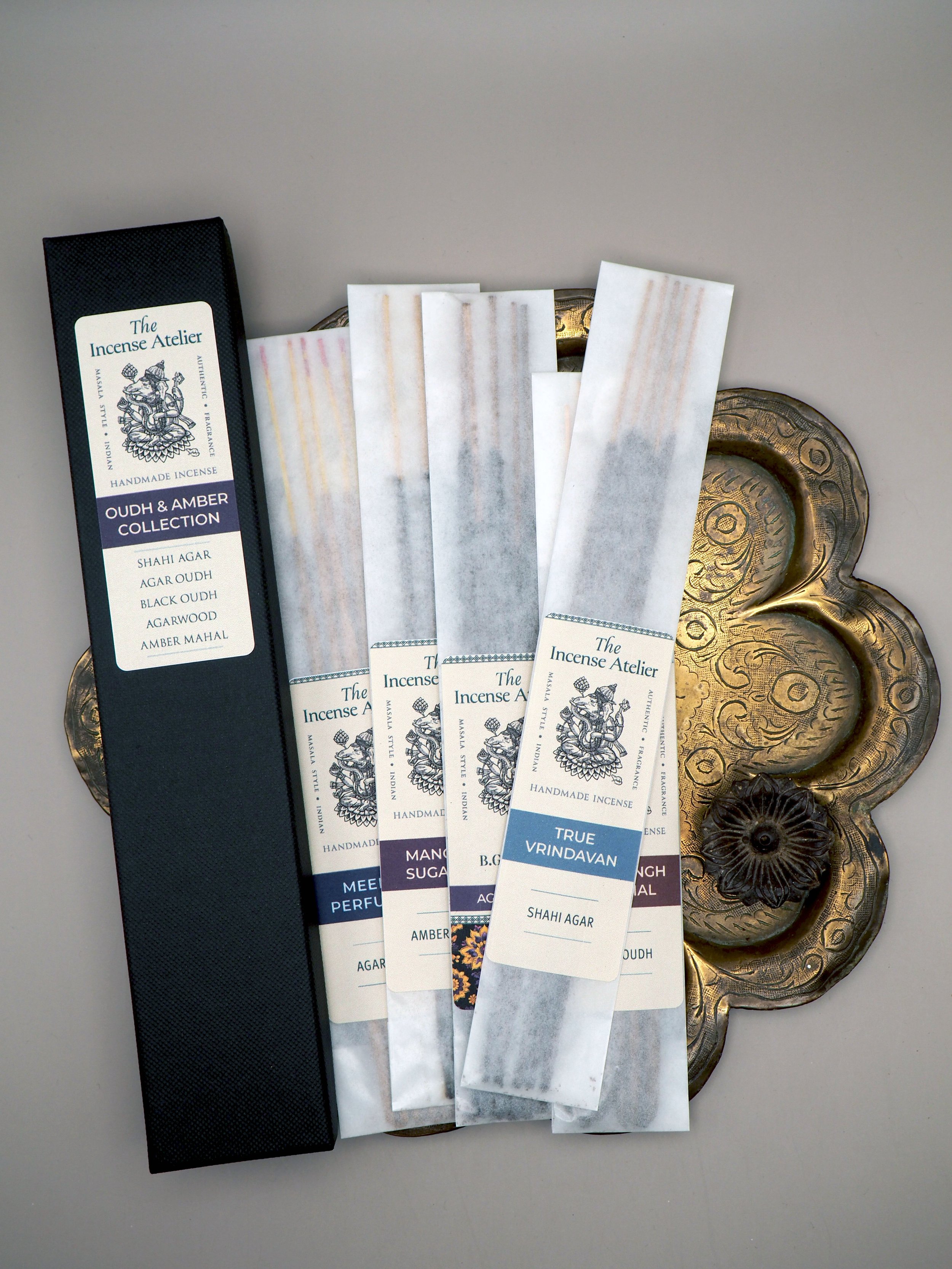
Oudh & Amber
Agarwood is one of those materials that means different things depending on where you encounter it. In Arabia and across the Islamic world, the resinous heartwood is soaked in aromatic oils and burned as bakhoor — a tradition of scenting spaces that is as much about hospitality as devotion. In India, that tradition meets the subcontinent's own incense-making culture, and the results are distinct.
The naming matters here. An oudh stick tends to be rich and dark, heavy with oil, often sweetened with rose or floral notes — the influence of attar tradition running through it. An agarwood stick is usually quieter: woodier, drier, more neutral in character. Some houses make both; the same raw material, read two different ways.
This set brings together five interpretations from across that range — from the honeyed depth of a true oudh style to the more restrained, wood-forward end of the spectrum. Taken together they give a reasonable map of the territory.
This discovery set comprises:
Shahi Agar – True Vrindavan
Agar Oudh– Meena’s Perfumery
Black Oudh – Gulabsingh Johrimal
Agarwood – BG Pooja Store
Amber Mahal – Manohar Sugandhi
25 sticks, 5 sticks of each variety, a total of no less than 50g of incense.
No results match your search. Try removing a few filters.